Jewellery

Etruscan Jewellery Part IV (ITALY)

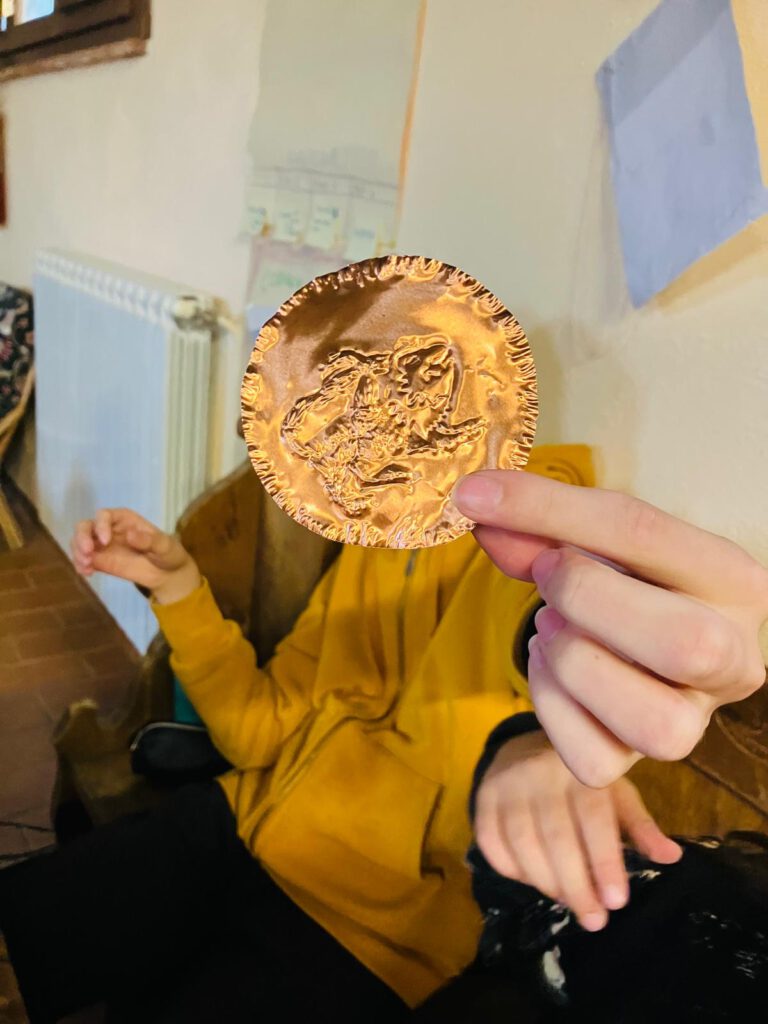
In the last meeting of the Erasmus Plus HAND! project, held at the Albero della Tuscia Libertarian School in Farnese (VT), elementary school children concluded the course on Etruscan crafts by making a plaque pendant depicting the Etruscan Chimera.Before beginning the hands-on activity, the children learned about the history and significance of the Chimera, a mythological creature depicted with a lion’s body, a goat’s head on its back and a snake-like tail. Among the most famous depictions was shown the Chimera of Arezzo, a fifth-century B.C. bronze sculpture found in 1553 and now housed in the National Archaeological Museum in Florence.In Greek mythology, the Chimera is a symbol of chaotic and destructive forces, but in Etruscan art it may also have taken on a meaning of protection and divine power. Its connection with the otherworldly world and its depiction on votive objects suggest a connection with the spirituality and religious beliefs of the Etruscans.After the introductory part, the children began the creation of their pendant, following the techniques learned in the previous meetings and using the technique of embossing on metal. To make the process accessible to all, the children were given a stylized, line drawing of the Chimera, which they transferred to the copper plate by overlapping the sheet and tracing the outlines with a pen. This first etching was then finished with burins to accentuate details and create a more pronounced three-dimensional effect. Once the design was complete, they cut out the shape of the pendant, beveled the edges, and, to make the pendant safer and more comfortable to wear, a thin layer of hot glue was applied to the back, which softened the reliefs and covered any sharp edges. Finally, with the help of jewelry pliers, the children drilled a hole in the plaque and inserted a connecting ring, finishing it off with a lanyard.This activity allowed the children to approach history through manual dexterity and creativity. Working with metal with their own hands, they were able to experience ancient techniques and discover the symbolic value of Etruscan artifacts. Each pendant, although starting from the same design, took on different nuances, thus becoming a unique and personal piece. This meeting closed the journey with a tangible memento of the work done, transforming knowledge into a concrete lived experience.

Etruscan Jewellery Part IV (ITALY) Read More »
Etruscan Jewellery Part III (ITALY)

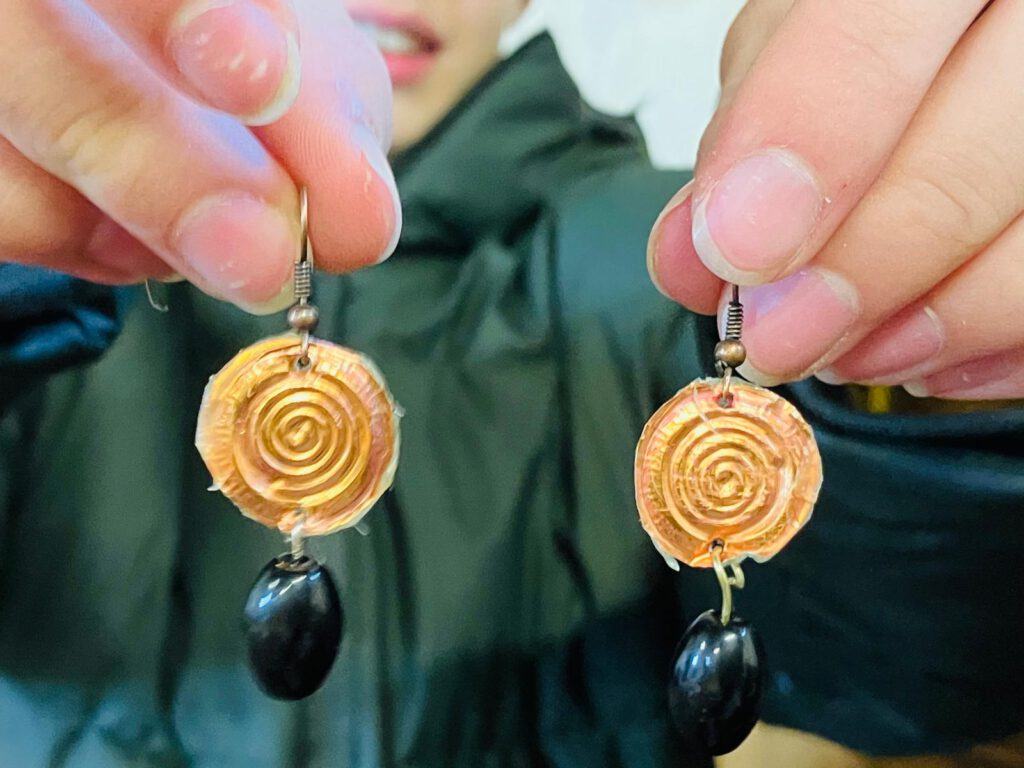
The third meeting of the Erasmus Plus HAND! project, held at the Albero della Tuscia Libertarian School in Farnese (VT), guided children to discover another fascinating artifact of Etruscan goldsmithing: earrings. This jewelry, beloved and worn by Etruscan women, came in different forms, from large plaque earrings, which could reach 7 cm in diameter, to pendants embellished with stones and fine details.After a historical introduction on the types of earrings used by the Etruscans, the children chose to make a pendant model, inspired by ancient jewelry but reinterpreted with a personal touch. For the workmanship, the technique of embossing on copper sheets was used, through which the spiral symbol was engraved. This motif recurs frequently in Etruscan art and symbolizes the continuous cycle of life, growth, transformation and the connection between the earthly and spiritual worlds.After transferring the design to the metal plate, the children engraved the spirals using burins and embossing tools, working carefully to achieve a well-defined relief. The resulting plaque was then personalized by adding a stone of their choice, inspired by the Etruscan custom of embellishing jewelry with precious and colorful materials. To ensure safety and comfort, a thin layer of hot glue was applied to the back, which softened the reliefs and covered any sharp edges. Next, through the use of jewelry pliers, the children assembled their earring, inserting the linking rings and completing it with the monachella, the hook that allows it to be worn.This workshop, too, offered children an immersive, hands-on experience, allowing them to explore Etruscan culture through craftsmanship and art. Working with metal, engraving ancient symbols and assembling a real piece of jewelry turned history into a hands-on experience, leaving them with not only an object to wear, but also an awareness of the artistic and symbolic value of jewelry from the past.

Etruscan Jewellery Part III (ITALY) Read More »

Etruscan jewelry Part II (ITALY)

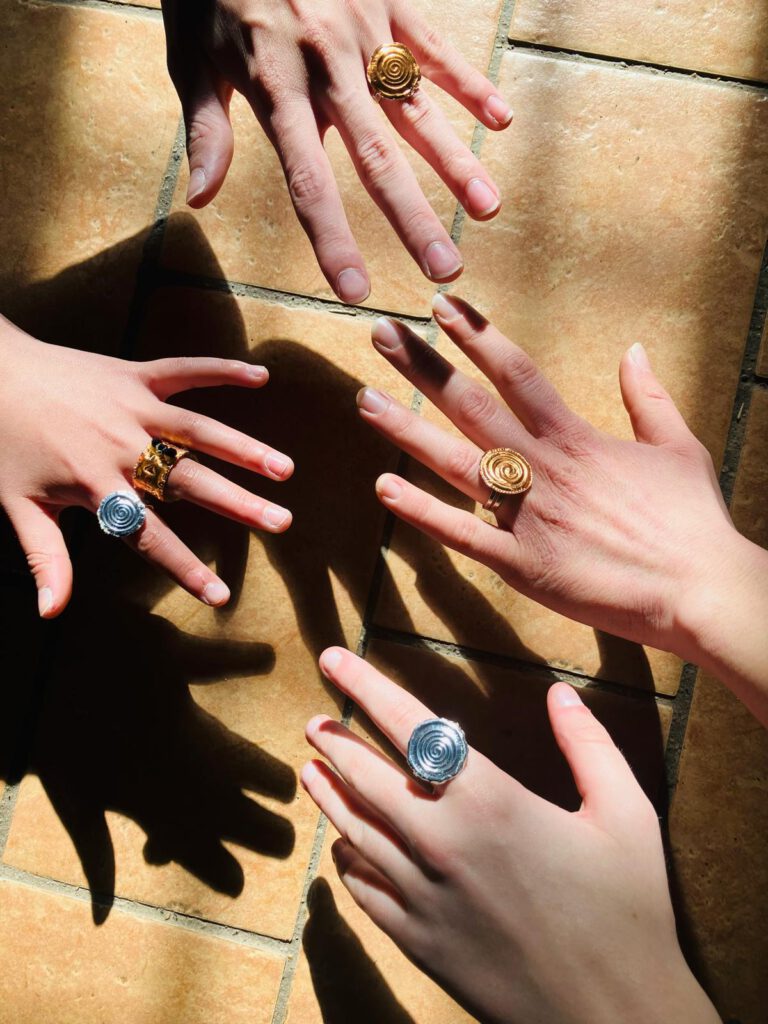
After the exciting discovery of Etruscan jewelry during the first meeting, the children of the Libertarian School “Albero della Tuscia” in Farnese (VT) continued their journey into the world of goldsmithing, experimenting with new techniques for making two types of rings: a band ring and a plate to be applied on a ring base.Also in this meeting, guided by Marianna Iurlo, the children worked with the embossing technique, choosing between copper plates or silver-plated bases, depending on their aesthetic preferences. The band ring was decorated with a design made freehand, then traced using burins to create a well-defined relief. Someone also applied black corallines to further embellish and personalize the work.The plate of the second ring, on the other hand, was obtained by tracing the relief motif of a jewel depicting a Spiral, a recurring symbol in Etruscan art. This motif was particularly significant to the Etruscans because it represented the cycle of life, fertility and prosperity, as explained in the previous meeting.Once the relief was imprinted on the slab, the piece was treated with hot glue to stabilize the workmanship and finally glued to the base of the ring, thus completing the creation. The meeting allowed the boys and girls to hone their manual skills and deepen their understanding of the symbolic value of Etruscan goldsmithing, transforming learning into a practical and creative experience. Through craftsmanship, they were able to experience firsthand the attention to detail and precision required for jewelry making, while developing a deeper connection to the history and art of antiquity.

Etruscan jewelry Part II (ITALY) Read More »

Etruscan jewelry (ITALY)

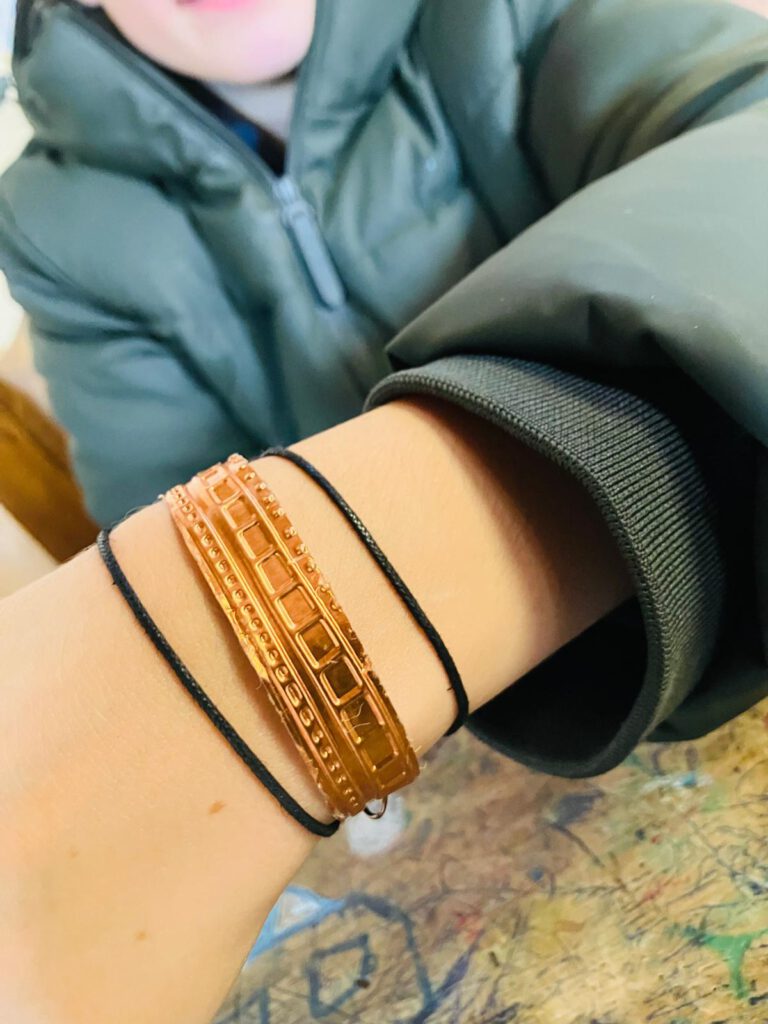
During the first meeting of the Erasmus Plus HAND! project at the Libertarian School “Albero della Tuscia” in Farnese (VT), elementary school children embarked on a fascinating journey to discover Etruscan jewelry. The presenter, Marianna Iurlo, told the story of the Etruscans, the ancient people of central Italy known for their skill in the art of goldsmithing, and explained how jewelry was not mere ornaments, but authentic symbols of wealth, protection and spirituality.The boys and girls learned that these precious objects, made of gold, silver, bronze, amber, and semi-precious stones, were embellished with refined techniques such as filigree, granulation, and especially embossing, which allows the creation of three-dimensional reliefs on metal. During the presentation, special attention was paid to the meaning of the symbols: the Sun represented life, light and energy, while the Moon was associated with the mysterious passage into the afterlife; the Serpent represented protection and renewal, the Eagle expressed power and connection with the heavens, and the Horse evoked nobility and strength. In addition, the Circle and Spiral recalled the continuous cycle of life, fertility and prosperity, while plants and flowers engraved on jewelry suggested rebirth and abundance. Some jewelry even featured formulas or incantations, intended to protect the wearer and connect the earthly world to the divine. To make this journey through time even more tangible, photographs of jewelry found in Etruscan tombs and housed in the Vulci museum were shown, giving children a direct visual connection to the past. Next, participants put what they learned into practice by making a band bracelet. Using a copper plate, the children experimented with the embossing technique: with the help of a die-cutting machine, a relief design was imprinted, which was then refined with burins to define the details. During the making of the bracelet, hot glue was used to fill in the reliefs and make the edges of the foil less sharp, thus providing greater security. In addition, through the use of jeweler’s pliers, terminals were applied to the bead and connector rings inserted, for an accurate and professional finish.This first meeting, aimed to combine learning about Etruscan history and culture with the direct experience of metalworking, strengthening the children’s sense of cultural belonging and creativity. A course that transformed knowledge into a concrete experience, stimulating creativity, teamwork and the discovery and appreciation of the artistic and historical heritage of the past.

Etruscan jewelry (ITALY) Read More »