Spinning & Weaving

Dreamcatcher ( ESTONIA)

In this workshop we discovered the deeper meaning of dreamcatcher and created our own piece. At the beginning of the lesson the story of the origin of dreamcatchers was introduced and then discussed with the children what will be the meaning each child is going to give to the decoration.  Before starting the crafting journey, we made a silent meditation circle, closed our eyes and made an endeavor for our decoration.  The children chose the loop made of natural material (made mainly of willow branches) and started weaving a net inside the ring. Various options were shown how to weave a net. Children could choose what kind of net they wished to make. It is incredible how many great ideas children have and how creative they are. If the weaving of the net has gone awry, then the whole work has to be unraveled and redone, which in turn gives the opportunity for a completely new approach.  Once the nets are woven, everyone can choose decorations made of recycled and natural materials to complete their dreamcatcher. The selection of materials includes figurines made of clay, strips cut from recycled cotton fabric, various wooden beads, and bird feathers and pine cones found in the forest. The children’s creations are different and everyone is very dedicated to their work, each dreamcatcher is unique and tells its own story.    

Dreamcatcher ( ESTONIA) Read More »
Flying Carpets (ESTONIA)

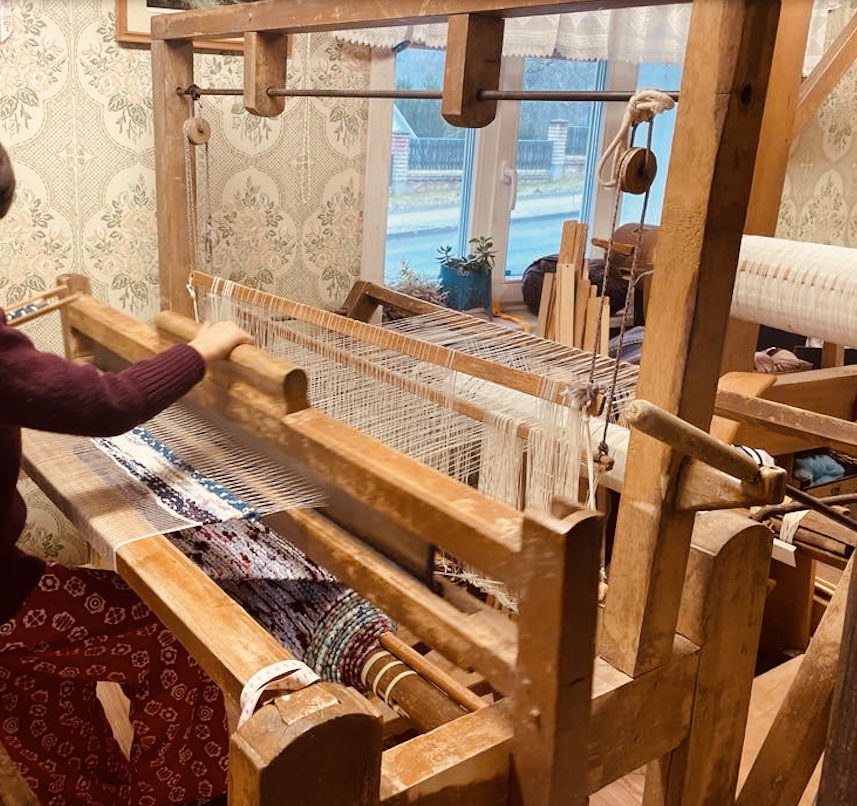
In this workshop we entered the world of traditional weaving with wooden framed looms. Estonian weaving has a long and vibrant history, with each region having its own unique patterns and styles. Weaving wasn’t just a skill; it was a way to express creativity and keep traditions alive. Patterns and designs often had special meanings and they were passed down from generation to generation. Children made carpets on small looms and bigger looms.  The process of setting up the Loom: First we got a whole bunch of threads ready. These are called the warp threads. They are like the backbone of the fabric and will run lengthwise. These warp threads needed to be carefully measured and wound onto a special part of the loom called the warp beam.   Then, each warp thread is threaded through tiny holes in things called heddles and then through a reed. The reed helps to keep the threads evenly spaced. This part can take a little while and needs to be done carefully and patiently! First the recycled fabric strips were chosen and with the help of the teacher the strips were tied to looms and then the fun part started. Then started the fun part of weaving. Children chose the recycled fabric strips for weft threads. These ran across the width of the fabric, going in and out of the warp threads. (The weft thread is wound onto a shuttle, which is like a little boat that you pass back and forth through the raised and lowered warp threads.) Every time you pass the shuttle with the weft thread across, you use a part of the loom called the beater to gently push the new weft thread into place, making the fabric nice and tight.  Kids enjoyed the process and said it is a very focused and fun and also social activity. It’s a great way to be creative and make something beautiful with your own hands. It is also a great way to learn about the history of how people used to make their own clothes and textiles. It’s like making art with threads, and it’s a skill that people have been using for thousands of years. As in old times people used to sing during working, we were also singing old folk songs to make the workshop feel even more like traveling back in time to our ancestors. Wonderful mini “flying” carpets were made for their other project called “miniature-world”. Looms will be placed in the school hall for everyday use.    

Flying Carpets (ESTONIA) Read More »

Transforming threads into little fabrics (ITALY)

We’re getting closer to the end of the year and the end of this workshop and the hand-spun wool is waiting to be transformed in something beautiful! Some threads are quite bold and we won’t double them, while others will be twisted to make them more stable. This is fun! The multi-coloured wool looks so beautiful when twisted.  Then we start weaving little ‘carpets’ using our hand-spun wool!  Slowly they are growing and some kids already think about who will receive them as a present for Christmas.  But also our woven bands from last week aren’t finished yet! Each child is choosing freely which project to continue. 

Transforming threads into little fabrics (ITALY) Read More »

Bandweaving (ITALY)

First of all we wanted to see how our dyed yarn turned out! Every child has chosen one jar to pull out the yarn from the dye. They look amazing!! Some colors are really bright for example the beetroot and  madder. While the pickle pear looses the color while drying in the sun. We write little labels to remember the dye we used for the future.  Back inside we start with todays main topic – Bandweaving. Every child chooses one rigid heddle and starts choosing the colors of the wool they would like to use. Preparing the heddle requires mathematics to understand the amount of threads needed and also some logical thinking to imagine how the pattern will look like afterwards. We soon realise that the preparation of the heddle is a long process of counting, measuring, ordering the threads and threading in the heddle. While listening to some theory about the structure of a weaving frame.  Once prepared all the heddles we can start weaving. To do so we decide to go outside and search for a fixed point to tie the backstrap loom. In the sun we find a fence that seems perfect. Let’s start! Weaving the first centimetres of our band we slowly get a feeling for the process. Some local woman passes by and is curious about what we’re doing. After some difficulties in the beginning the bands are growing, and it’s fun!!  Time flew and we soon have to tidy up. Next week we want to continue our band but all continue to spin some wool for a further project! 

Bandweaving (ITALY) Read More »

All about natural dyes! (ITALY)

Wool comes in so many colors, that’s for sure. But where do they come from? Plants, Animals or only some chemicals? To get a first feeling for different natural dyes the children divide a basket full of coloured wool into natural colors and artificial ones. Then we talk about which colors where really natural. There are soooo many colors nature can create! A full rainbow.  But now we want to try to colour some wool on our own. In some prepared jars we have water with roots (woad), pomegranate skin, red wine or beetroot pieces inside. The color of the water has already changed and we add some white sheep wool to see what will happen. Due to the fact that we won’t heat it up but just leave it in the liquid for some days, the result will be clear next week. We decided not to use any morband to remain fully natural. Only some salt and vinegar to fix the colors better.  After some time inside, talking about dying plants, roots and even insects that are used to dye wool the children ask to go outside to collect some dying plants on our own. We find acorns and many different green leaves that we want to experiment with. Let’s see what will happen!  The last hour of the lesson we continue spinning wool and are getting better and better! Already the first little balls of wool are done and will wait to be used in a little weaving project in some weeks. 

All about natural dyes! (ITALY) Read More »

Local Wool Situation and Improve Spinning (ITALY)

It’s Friday again and we meet for the second time to learn more about natural fibres and their transformation.  After a short repetition of what we’ve learnt last week we talked about the local situation of shepherds. In our region there are many sheep that came with their owners from Sardegna many years ago. Nowadays its nearly impossible for them to sell the wool, instead they have to pay for the disposal because it’s seen as special waste. Many of them hide the wool or collect it in their farm to not pay for it.  When the children hear this, one girl shouts: WE WILL USE THE WOOOL!  Then we watched a short documentary about how farmers from Tuscany shear the sheep, the children remain surprised that they bond the legs of the sheep to keep it still.  Afterwards the children ask to see a video how the silk worm is creating a threat of silk. We were all impressed and wondered if the folder is still in the cocoon when they cook it. Poor folders!!! In the end we watched a short film about the cultivation of cotton in Sicily that restarted a few years ago.  After some theory we continue to practice to spin more wool and talk about what we’d like to create with the wool once it’s a bigger amount. Maybe a small little rug? In different shades of grey, white, black and brown. The children love the new wool that arrived from north Italy. It’s so sooooft! The enthusiasm is big about finding different ways to spin alone and helping each other. Then the idea came up to make an extra long threat down the wall. One stays up preparing the wool while the other is spinning the spindle down. The longest thread of Gradoli!!! To close the session we decided what we’d like to learn the next times. Natural colors, weaving bands!

Local Wool Situation and Improve Spinning (ITALY) Read More »

First meeting – Spinning and weaving (ITALY)

Today was our first meeting of the spinning and weaving course at gradoli, a small village close to Lake Bolsena.  We start to get in touch with different types of fibers – plant based, like flax, hemp and nettles and animal based ones, like wool and silk.  To get a first idea the children get various forms of fibers in raw or already processed form and pair them with illustrated cards with images of the different fiber plants and animals. They are impressed by the variety of fabrics and their origin – silk, nettles, hemp, flax, alpaca, sheep wool and even agave. A worm that creates silk? What a surprise! And even from the banana plant a fiber can be extracted!  After exploring the fibers by touching and smelling them (unwashed sheep wool is reaaally smelly!!) we start to prepare the sheep wool to spin our first threat.  The first step is to remove all the straw pieces and other dirt (luckily we had already pre washed wool) and make the wool more fluffy.  Then we take some dog brushes to card the wool – the last step before spinning it. After preparing the black and white wool we can start spinning. Some children start with alpaca wool, which is softer and quite easy to spin while others mix black and white sheep wool. The motivation to spin enough for a carpet or a sweater is big!  In the beginning we share the work, one is spinning the spindle while the other is preparing the wool supply. Then we change the roles. In the end some are even trying to spin and prepare the wool and create their first own threat! Such a satisfaction!  After two hours we write the names on the spindles to remember which one is who’s for the next week and tidy up the room. 

First meeting – Spinning and weaving (ITALY) Read More »